


Robots, air mobility industry, Enterprise AI: Which Sector Will Turn Hype Into Revenue First in 2026...
原创 Vera | 2026-04-24 22:17
【数据猿导读】 April in Hong Kong. Deep in the nightscape of Victoria Harbour, Gerd Müller, Director General of the United Nations Industrial Development Organization appeared in person at the Hong Kong Convention and Exhibition Centre to att...

April in Hong Kong. Deep in the nightscape of Victoria Harbour, Gerd Müller, Director General of the United Nations Industrial Development Organization appeared in person at the Hong Kong Convention and Exhibition Centre to attend the opening of a technology expo. It was a showcase of technological confidence, but also a place where optimism can sometimes run ahead of execution.
This year’s InnoEX, themed “Innovation • Intelligence • Takeoff,” focused on five key areas: AI+, robotics, the low-altitude economy, proptech, and retail tech. By the final days of the four-day event, one thing had already become clear: the exhibition offered an early read on how industrial priorities are shifting—and where Hong Kong hopes to position itself in that shift.
What mattered more than the crowds or product demonstrations was how directly exhibitors were talking about deployment. This year’s InnoEX deserves close attention from business decision-makers: the commercialization pace of embodied AI is accelerating, the low-altitude economy is entering enterprise markets via regulatory sandboxes, and Hong Kong’s role as a hub in the cross-border “AI + manufacturing” supply chain is being revalued.
At InnoEX 2026, a clearer picture emerged of how industrial AI is evolving in China and across Asia—showing where progress is real and where the gap between promise and execution remains wide.

RoboPark: A Timeline of Industrialization
A new “RoboPark” zone debuted this year, spanning both InnoEX and the concurrent Spring Electronics Fair. It brought together over 100 robots from more than 50 tech companies across China and oversea. What mattered more than the numbers was which companies were exhibiting.
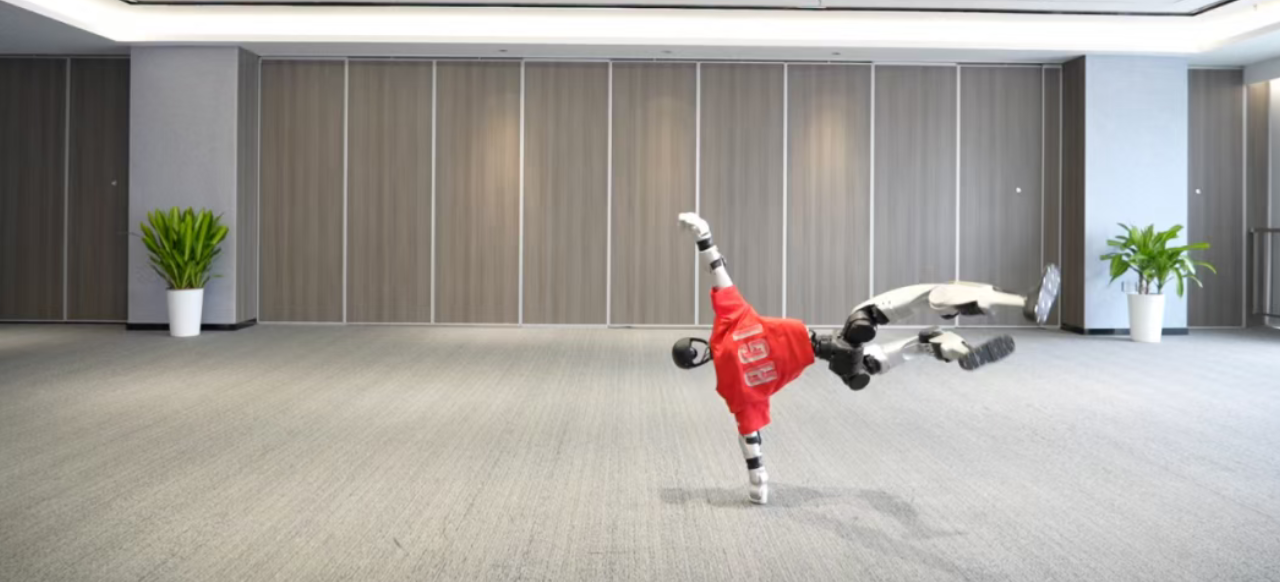
Several of the world’s leading humanoid robot makers were present, including AgiBot, Unitree Robotics, UBTECH Robotics and EngineAI—companies widely seen as part of China’s emerging humanoid robotics cluster. Others on the floor included AI² Robotics, LimX Dynamics, PaXini Tech and Digit Robotics.
For companies focused on enterprise deployment, the lineup is worth a closer look.

Take Unitree Robotics as an example. Its new-generation quadruped robot, the Unitree A2, made its first appearance oversea at this year’s show. The machine can run up to 5 m/s, climb heights of 1 meter, and features ultra-wide-angle LiDAR for real-time 3D perception. In demonstrations, it remains stable even when a 100 kg adult jumps on it and operates reliably on rough terrain. —less a consumer showcase than a benchmark for industrial-grade reliability.
Hong Kong-based companies are also notable. Rice Robotics showcased autonomous robots designed for repetitive operations in office buildings, covering delivery, cleaning, disinfection, and security patrols. Built on proprietary navigation software and integrated with elevators and access-control systems, these robots can move through office buildings without human intervention and are already in use at SoftBank, 7-Eleven Japan, and Mitsui Fudosan.

The strategy is clear: use Japan as an early proving ground. Manufacturing and service environments there impose unusually high standards on reliability, safety, and maintenance. For mainland firms targeting mature B2B customers, succeeding in Japan can mark the shift from product demonstration to commercial delivery.
Behind official statements about “cross-regional collaboration” lies a reality: for mainland robotics firms, the main constraint is no longer technological capability, but certification requirements, compliance costs and the slower work of building trust in markets such as Europe, Southeast Asia and the Middle East. Hong Kong offers a “compliance buffer zone” supported by its common law system and global financial status.
However, a key issue remains: most robot applications on display are still highly scripted demos. From factory inspection to logistics sorting, from hospital dispensing to office cleaning, the direction is correct, but scalable, replicable commercial deployment remains distant. Valuations and roadmaps are often overly optimistic. The real test will come during maintenance cycles: failure rates, downtime costs, and service responsiveness must support a viable ROI. No exhibitor is answering this yet.

Air Mobility: From Regulatory Sandboxes to Market Entry
This year marked the debut of a Low-Altitude Economy Conference, held alongside a government-backed task force and a separate exhibition zone. Participating companies included Haihong Technology, Harmony Aviation, and DAMODA.
The significance goes beyond the exhibition floor. In March last year, Hong Kong launched a regulatory sandbox for low-altitude economy projects, giving companies a controlled setting to trial early commercial use cases. The first batch included 38 projects across emergency response, logistics, inspection, and infrastructure, and more than 20 have since moved into routine operations.
This means the sandbox is not symbolic, it functions as a real screening mechanism. Companies must pass flight data scrutiny, safety evaluations, and commercial feasibility tests before scaling up. For firms using Hong Kong as a gateway to global markets, that offers a meaningful layer of validation. The upgraded “Sandbox X” will expand into more complex scenarios, such as unmanned traffic management systems.
Meanwhile, China Mobile Hong Kong demonstrated UAV traffic management and 5G + satellite connectivity,touching the core infrastructure layer of the low-altitude economy. Airspace networks are not optional; they are essential to scaling.
From the mainland side, the policy signal is straightforward.A February 2026 directive mandates that by 2027, over 90% of low-altitude air routes must be covered by ground mobile communication networks—opening a new phase of infrastructure spending and commercial opportunity.
Yet a structural problem persists: market enthusiasm still runs well ahead of commercialization. Most use cases remain concentrated in agriculture, inspection, and logistics, with few stable profit models. The industry is at a tipping point—many companies have subsidies and pilot projects, but few have repeat-paying customers.
Hong Kong’s sandbox forces that question early: who pays, how much, and why one company wins the contract over another Finding out before funding runs low is far cheaper than learning it after years of burn.
AI+: Where the Real Competition Is Taking Shape
Major players such as Huawei International, China Mobile (Hong Kong), iFlytek, Tencent Cloud International, and Lenovo (Hong Kong) brought enterprise AI solutions.
One shift stood out: large-model capability is no longer a primary differentiator. Integration with real-world deployment, access to industry data and the ability to navigate compliance are emerging as the more durable competitive advantages.
Tencent Cloud presented products like SuperApp and PalmAI, while iFlytek focused on enterprise voice and multimodal deployment. Together, they pointed to a broader shift: attention is moving away from foundation models alone and toward downstream deployment in industry-specific settings.
Companies like TapData, Inspur Cloud, and Woqu Tech emphasized real-time data integration, cloud-native platforms, and database intelligence aligning with the “data-driven decision-making” trend. Others exhibitors focused on brain-inspired AI and multimodal applications across government, media, and enterprise services.
The policy backdrop is supportive. A directive issued in January 2026 calls for a more secure supply of core AI technologies and sets a 2027 target for China to take a leading global position in the sector. InnoEX reflects both that broader national push and Hong Kong’s own strategy of attracting investment through deployable, scenario-based projects.
One place this shift is already visible is proptech. Despite real estate downturns, enterprise demand is rising: companies are using AI and IoT to cut operating costs, while digital twins are gaining traction in asset management. In many cases, procurement budgets are already in place.
Still, caution is necessary. While AI is transforming industry, every investment still has to prove its economic value. Moving from demo to deployment involves long, complex integration phases—one that is rarely visible at exhibition booths.
Hong Kong’s Role: Where Technology Meets Market Entry
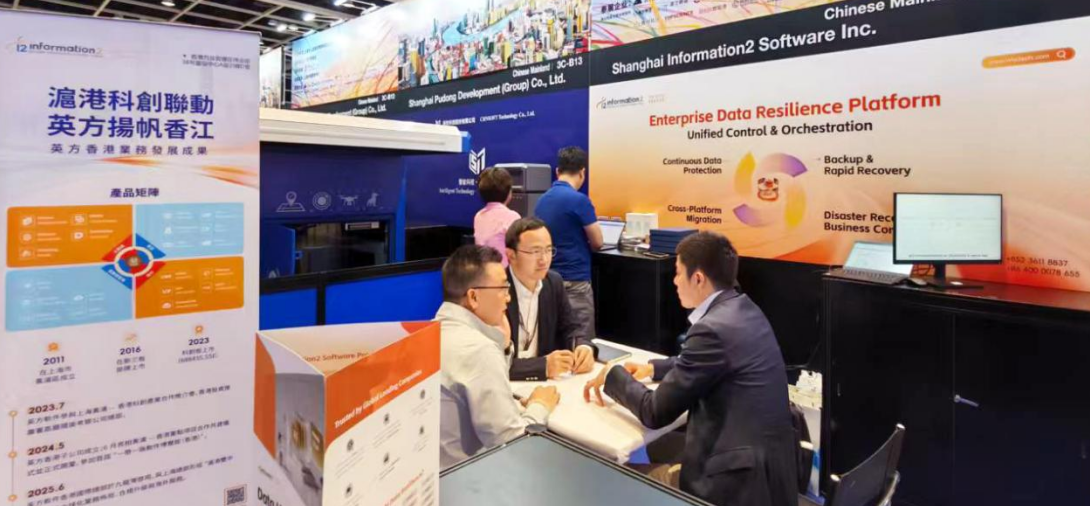
This year’s InnoEX attracted over 550 exhibitors from 21 countries and regions, including first-time participants from Austria, Germany, Hungary, Israel, Kazakhstan, the Netherlands, the Philippines and China also had strong representation.
Hong Kong is emerging as one of the most practical entry points for Chinese technology companies expanding overseas.
A robotics company in Shenzhen, for example, can use Hong Kong to solve several practical issues at once: dual-currency settlement, contracts governed by common law, and direct access to global buyers within a single venue.
That advantage is amplified when buyers and suppliers are concentrated in one place. Together, InnoEX and the concurrent Hong Kong Electronics Fair drew more than 2,800 exhibitors, creating a concentration of supply and demand that would be difficult to replicate independently.
The exhibition’s importance also extends beyond dealmaking. Its alignment with both national industrial priorities and Hong Kong’s own policy agenda gives it a signaling role, shaping expectations around where capital and policy support may flow next.
However, Hong Kong’s local manufacturing supply chain remains limited. It works well as a place to negotiate and structure deals, but not yet as a fully developed industrial base. As a platform for global deals, it is highly efficient; as a production hub, expectations must be managed.
Three Questions Industry Observers Must Answer
After the exhibition, the more substantive questions remain:
First is timing. Credible third-party data on robotics ROI remains limited, with most claims still based on company-reported metrics. Large-scale independent validation will be essential.
Second is demand. In air mobility, hardware, infrastructure and regulation are largely in place, but sustained enterprise demand remains uncertain. Given procurement cycles, broader growth may not arrive until 2027 or 2028.
Third is cost. Enterprise AI integration is often underestimated. API access is inexpensive, but embedding AI into ERP, MES and quality systems can still take 12 to 24 months of customization.
Technology Is Ready, The Bottleneck Lies Elsewhere
Now in its fourth edition, InnoEX was the most international yet. With strong national backing and broader global participation, Hong Kong’s role as an innovation hub no longer looks aspirational—it is increasingly institutionalized.
For industry observers, however, the more important question lies in what happens between stages: how quickly a working demo becomes a production system, and whether a pilot project turns into repeat orders.
Robotics, the low-altitude economy, and enterprise AI have all entered a more industrial phase. Technology is ready, engineering is mature, and policy is broadly supportive.
The harder constraints now lie elsewhere: customer education, business-model validation and system integration. Beneath the optimism, one commercial reality remains unchanged—enterprise buyers still care most about predictable returns.
The exhibition has ended. What comes next is a test of which sector can turn hype into revenue first.
来源:数智猿
刷新相关文章

















































































我要评论
不容错过的资讯






大家都在搜


